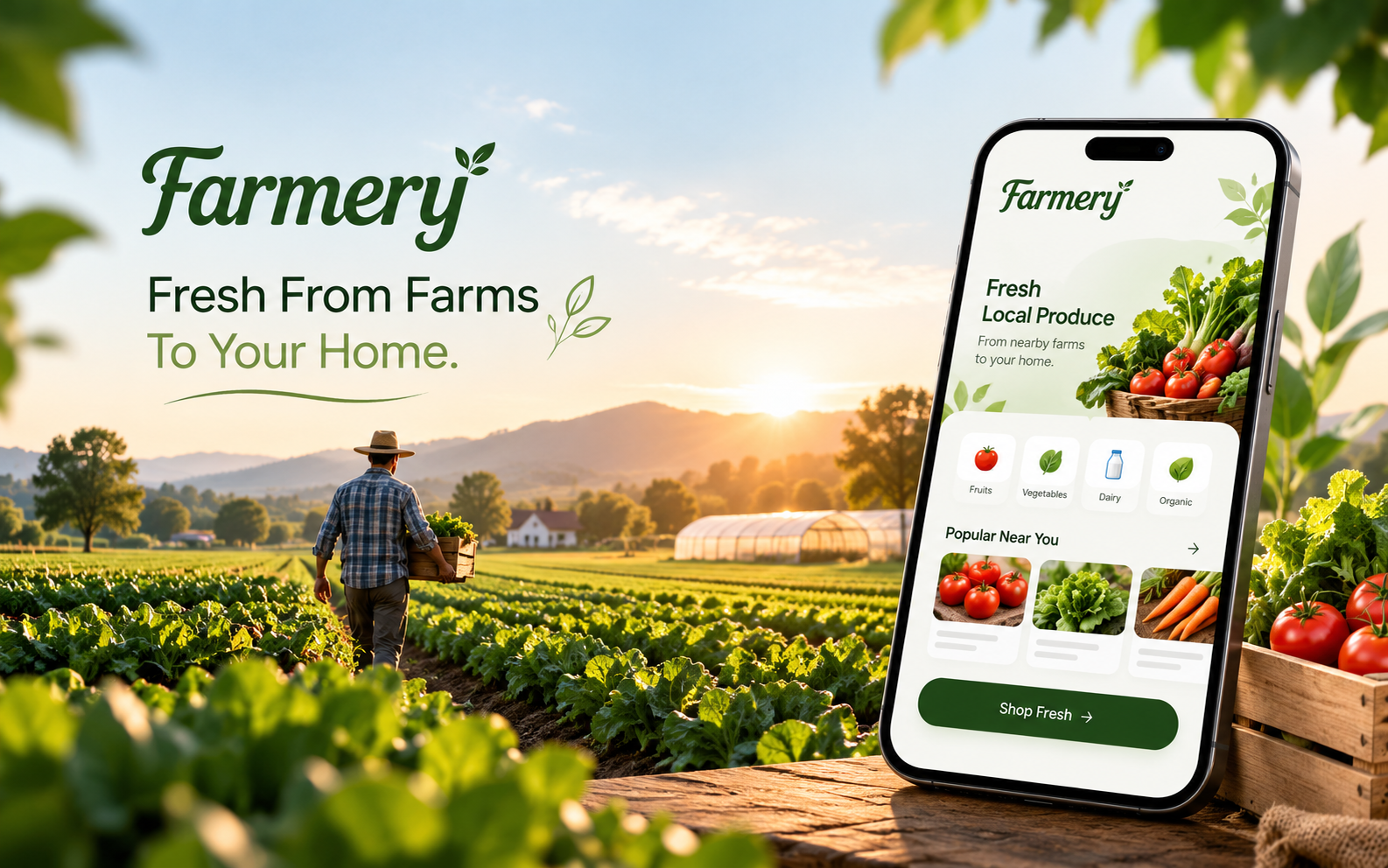
A story worth discovering. An everyday experience worth returning to.
Farmery is a farm-fresh milk, dairy and grocery business operating in Delhi NCR. The project addressed an existing digital experience as the company planned to expand its product category and launch groceries.
The website needed to build engagement through storytelling and brand insights. The app had a separate commercial role: order management, tracking, payments and offers.
Company
Expedien India Pvt. Ltd.
Role
Lead Product Designer
Year
2019
Scope
Website · Digital product · Research
02 / Farmery
About the Brand
Freshness, quality and the supply chain behind a daily essential.
From the farm. To the dining table.
The source brand overview describes a focus on good-quality farm-fresh food, beginning with milk and dairy before bringing more farm-fresh products to households.
Farmery’s overview states that quality testing is conducted through FSSAI-accredited laboratories to check for pesticides, chemicals and preservatives. This is the brand’s stated positioning, not an independent certification assessment by this case study.
Supply-chain knowledge and daily delivery sit at the heart of the brand story.
Origin → Quality → Everyday
New visual exploration / not original product photography
03 / Farmery
The Challenge
The source identifies two main design challenges, rather than one interface doing everything.
01 / Website
Engagement before transaction.
Design the website for engagement, storytelling and brand insights. The existing basic experience supported commercial presence, but the source described it as insufficient for rising online-grocery competition.
02 / App
Clarity in the everyday.
Support the commercial side of the company: order management, order tracking, payment and new offers. This scope does not imply redesigning inventory management or delivery-person systems.
04 / Farmery
Understanding the Business
Business context recorded in the original project material. Historical figures, not current market data.
Understand the business. Then shape the experience.
The source describes a deep dive into the milk and grocery digital marketplace, looking at ROI, market, customer acquisition, demographics and sales.
The Dairy
$120B
Estimated dairy market in the source
$70B
Organized sector in the source
Farm-fresh milk is described as less than 1% of the dairy market, with an expectation of growth to 5% by 2020. The source discusses emerging players, quality at scale, cattle nutrition, operational practices and growing awareness.
The Grocery
The source contrasts horizontal players with specialist verticals built around assortment, express delivery and subscriptions. It reports retail-spend ranges of 35–40% online, 30–40% at local kirana stores and 20–30% across modern retail formats.
Figures and the 2020 forecast are reproduced as historical source context. The supplied slide does not provide citations; they are not presented as independently verified facts or results of this design work.
05 / Farmery
Farmery’s Supply Chain Story
The six-step business story from the original material. A supply-chain narrative, not an operational-system redesign.
The everyday journey / 01
Farm
The everyday journey begins at the farm, with farm-fresh products destined for customers’ doorsteps.
06 / Farmery
Key Assumptions
Starting assumptions, explicitly separate from the research that follows.
Business assumptions
Farmery is an organic milk and grocery delivery service operating in Delhi NCR.
Farmery manages the inventory of its products.
Inventory management software and a separate app for delivery persons are already there.
Customer assumptions
The source describes the assumed customer segment as “Customers with big pocket.” This is an assumption, not a validated demographic finding.
Possible milk, milk-product and grocery demand windows: morning 7am–9am and evening 7pm–9pm.
07 / Farmery
Project Research
The research plan separated assumptions-based data from proven data before defining the questions.
The first document was a research plan covering stakeholders, background, competitive research, methods, questions, participants and timeline. Existing company information was gathered and visualized to identify what the research needed to clarify.
Quantitative research
A survey of everyday habits.
200
Participants invited
114
Responses received
The source describes a mix of professionals, homemakers and students, with strawberries given as incentives.
Qualitative research
Listen. Observe. Understand.
Three interview groups: Working parents, Elderly, Fitness enthusiasts. The source reports 16 in-person interviews and 4 telephone interviews from each group; no combined participant total is inferred here.
Open-ended questions
Close-ended questions
Observation-based questions
The source describes a Master & Apprentice approach: observing hand gestures and behaviour while listening, rather than telling users what to do.
08 / Farmery
Research Findings
Survey observations reproduced as reported. Not business outcomes or usability-test results.
59%
Working & married
59% of the targeted users are described as working professionals and married.
72%
Morning preference
72% prefer buying milk in the morning, compared with 20% in the evening.
52%
Daily vendor payment
Daily and monthly payment patterns are reported at 52% and 48%, respectively.
The morning and evening figures are not normalized to 100%; the remainder is not explained in the source. The two uploaded research images repeat the same content and are not counted as separate studies. Detailed interview transcripts and additional findings were not supplied.
09 / Farmery
User Flow and Experience Architecture
Brand discovery, community participation and commerce share one experience architecture.
Architecture reading guide
Discover
Product branches include Dairy, Fruits and Grocery. Dairy expands into Cow Milk, Buffalo Milk, Curd and Ghee.
Why Farmery
Product
Search
Blog
Source-backed architecture groups. This interactive reading guide groups documented labels; it does not reproduce every original connection or claim live functionality.
10 / Farmery
Design Direction and Solution
Design direction drawn from the brief and the supplied website visuals — not a claim of measured impact.
Make the origin visible. Keep the everyday practical.
The supplied website design leads with the farm-to-doorstep journey. Location-based community content brings the brand closer to the people it serves.
Alongside that engagement experience, the source architecture documents products, quantity selection, checkout, card and wallet payment, and account management. These paths describe the intended experience, not verified production behaviour.
11 / Farmery
Website Experience
A new interactive exploration of storytelling, product discovery and community — distinct from the original website.
Reimagined website / Interactive concept
● ● ●farmery / design exploration
farmery.
From the farm. For your everyday.
Fresh beginnings. Every morning.
Origin, community & everyday essentials
New design exploration with illustrative imagery. Not the original 2019 website, a tested prototype or a live shopping service.
12 / Farmery
Mobile Product Experience
A working design concept based on the commercial brief, not supplied final app screens or verified production behaviour.
Reimagined mobile / Simulated journey
An everyday order. Without the friction.
A new interaction concept exploring product selection, locality, card or wallet payment, and order management from the source brief.
01Choose your dairy
02Review your order
03Simulate payment
04Manage delivery
Demo only. No real order, charge, delivery, account or personal information. These interactions have not been usability-tested.
9:41● ▰
farmery.
Your daily essentials
A fresher everyday.
Cow Milk
Quantity
13 / Farmery
Key Design Decisions
A synthesis of the source challenge, architecture and visible designs. Design rationale, not tested conclusions.
01
Separate the roles
Let the website carry brand engagement while the app supports the commercial experience.
02
Show the origin
Bring the farm-to-doorstep supply-chain story into the website’s first impression.
03
Connect the locality
Use the supplied community and location architecture to connect brand content with the areas served.
04
Respect operational boundaries
Treat existing inventory software and the delivery-person app as assumptions about the project boundary, not systems claimed as redesigned.
14 / Farmery
Reflection and Learnings
What the supplied material supports — and what remains open.
A daily essential. A connected digital story.
The source-backed lesson is to understand the business and distinguish assumptions from evidence before shaping the experience. For Farmery, the brand’s story and the customer’s daily tasks called for related but distinct digital roles.
The references document context, research, user-flow architecture and website designs. They do not establish launch status, conversion changes, customer outcomes or usability scores.
The interactive website and ordering experiences on this page are new design explorations, not original 2019 artifacts or validated outcomes.